Product Introduction
I. Product Overview
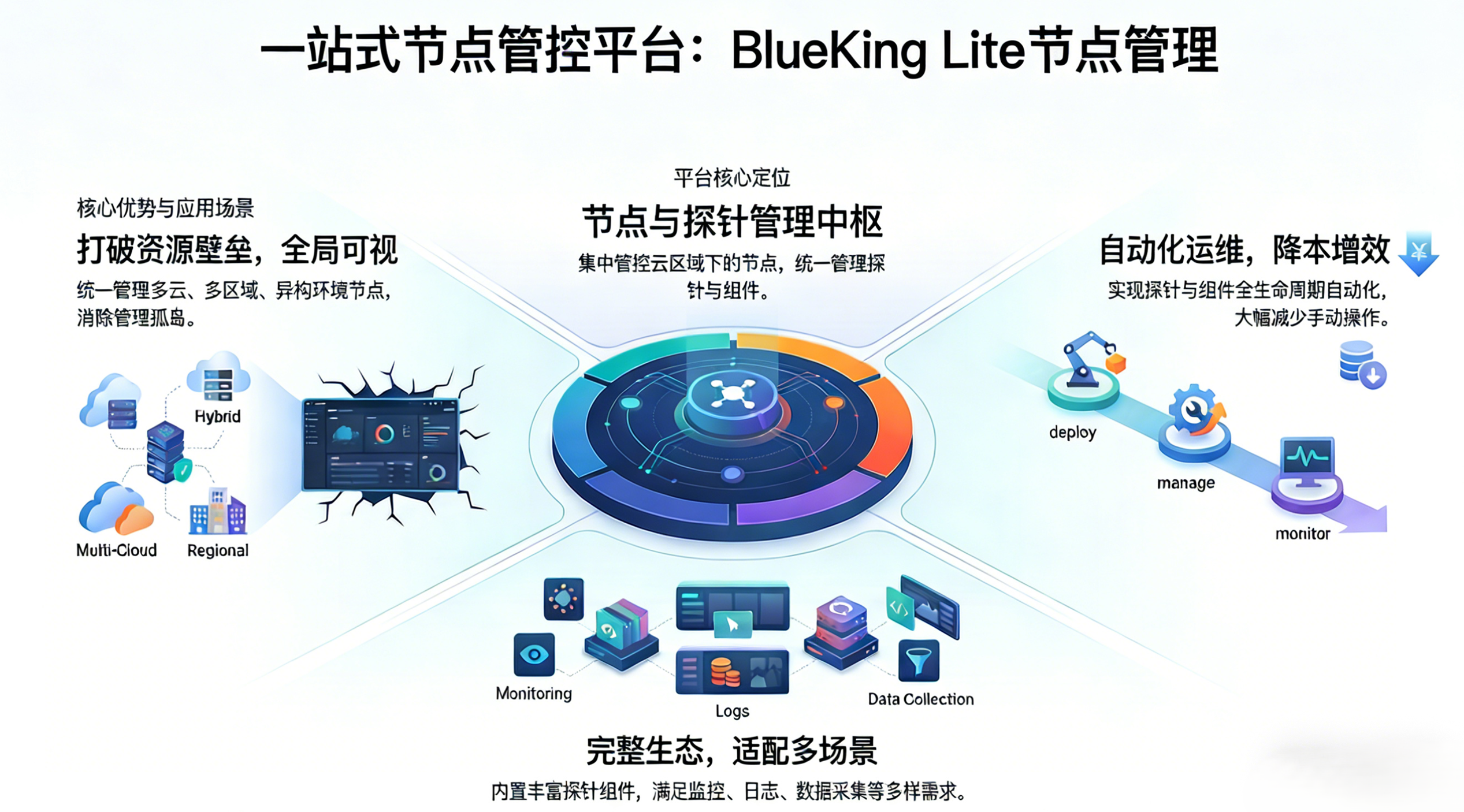
Node Management is a node and collection component management hub built on BlueKing Lite, dedicated to centralized management and control of nodes, controllers, collectors, and collection configurations within cloud regions. Through unified node onboarding, component installation, configuration distribution, and operational maintenance, it provides foundational support for business scenarios such as monitoring data collection, log collection, and CMDB synchronization.
Leveraging its lightweight architecture, standardized configuration system, and package governance capabilities, the Node Management module achieves unified management across multi-cloud regions, heterogeneous operating systems, and multi-CPU architectures, significantly simplifying the full-lifecycle operations and maintenance workflow for cloud resources and collection components.
II. Core Competitive Advantages
-
Centralized Cloud Node Management, Breaking Down Resource Barriers Unified management of node resources across multi-region networks, with visual display of node distribution and status across regions, eliminating barriers of distributed management and gaining precise control over global node assets.
-
Automated Operations for Efficiency, Reducing Manual Costs Leveraging Linux/Windows controllers, achieves full-process automation for collector and component deployment, configuration, and maintenance on nodes. Combined with a standardized configuration distribution system based on primary-secondary isolation, core operations require no tedious manual intervention, significantly improving large-scale operations efficiency.
-
Complete Probe and Component Ecosystem, Adapting to Multiple Scenarios Built-in open component library and package management system, providing rich collectors and version packages such as Telegraf, Beats, etc., compatible with Linux (x86_64 / ARM64), Windows, and multi-CPU architectures, comprehensively meeting diverse business needs for monitoring, logging, CMDB, and beyond.
-
Multi-Architecture Auto-Routing, Zero-Friction Cross-Platform Deployment Remote installation automatically detects target node CPU architecture; curl/bootstrap installation automatically identifies local architecture and distributes matching installer and controller packages by OS + architecture, eliminating manual selection. Node CPU architecture attributes are persisted and recorded, enabling batch backfill for legacy nodes as needed.
-
End-to-End Security Hardening, Zero Credential Leakage Task execution credentials (SSH passwords/private keys) are automatically masked before storage and never written to disk. Node installation sessions use dedicated minimum-privilege credentials rather than full admin credentials. Node organizational membership is synchronized incrementally, eliminating permission drift risks.
III. Application Scenarios
-
Unified Multi-Cloud Region Resource Management Centralized management and control of node resources across different cloud regions, precise tracking of node distribution, status, and associated components per region, achieving global visibility and unified operations for cloud resources.
-
Full Lifecycle Probe Management Accelerate the deployment, configuration, and maintenance of various collectors and components on nodes, laying the foundation for business scenarios such as monitoring collection, log collection, and metric reporting.
-
Cross-Node Operations Automation Leverage controllers to achieve batch deployment, upgrade, and management of collectors and components across multiple nodes, meeting the operational needs of large-scale node clusters and improving scalable operations efficiency.
-
Heterogeneous Environment Adaptation Support Full compatibility with Linux (x86_64 / ARM64), Windows, and other multi-OS, multi-architecture nodes, with automatic detection of target architecture during installation and distribution of matching controller and collector packages, flexibly supporting business implementation in heterogeneous environments.
-
Production-Grade Security-Compliant Operations SSH passwords, private keys, and other sensitive credentials are never written to disk during task execution. Installation sessions employ minimum-privilege isolation. Node organizational membership is synchronized incrementally, meeting operations requirements in high-security and compliance scenarios.