A Core Asset Changed. Why Does the Team Only Find Out After an Incident?
Twenty minutes before month-end settlement, Xiao Zhou receives a ticket about payment callback timeouts.
He first contacts the service group according to the owner in the asset ledger. The reply is: "This component was transferred to another group last week." He then checks the gateway address and still sees the old IP from before the migration. Following the dependency relationships downward, he finds that the associations were also adjusted a few days ago.
The page is not short of information. Owner changes, address updates, and relationship adjustments all have records. But before this failure actually happened, neither the on-call team nor the service owner had seen those changes.
Xiao Zhou is holding an updated ledger, yet still troubleshooting according to yesterday's facts.

The Scene Gets Stuck
This kind of problem is easily blamed on "inaccurate CMDB data." But in many cases, the asset data itself has already changed. What gets stuck is that the change never entered the collaboration chain.
The ledger is responsible for preserving facts: who owns the asset, where the instance is, and what it is related to. But incident response depends on more than the facts themselves. After facts change, the team also needs to know who should reconfirm them and who needs to adjust their actions accordingly.
If this step does not happen, the team pays three extra costs during the failure: first confirming whether the object is right, then confirming whether the relationship is new, and finally confirming who should be contacted now. The greater the pressure, the more easily these three steps slow each other down.
Change records can only prove "what happened"; change awareness decides "who has a chance to know before the incident."
The Root Cause Is a Collaboration Gap
Some people may say: if change records exist, why not just check them during troubleshooting?
That judgment assumes one thing: the troubleshooter knows which asset to check from the beginning. Reality is usually the opposite. Xiao Zhou enters the scene from a timeout ticket. The first things he encounters are an old contact, an old address, and old relationships. By the time he thinks of checking records, time has already been spent on the first round of wrong assumptions.
Broadcasting all changes to the on-call group does not work better. When there are many assets and the environment changes quickly, a large number of low-value updates will bury the truly important changes. Recipients will soon treat notifications as background noise.
So change notification is not about "sending more messages." It is about reorganizing an asset fact according to responsibility boundaries. It needs to answer at least three questions at the same time:
| What to Constrain | Question in the Scene | Consequence Without Boundaries |
|---|---|---|
| Scope of attention | Which assets deserve continuous attention? | Full broadcast or missed key objects |
| Triggering events | Which kinds of changes require action? | Owner changes and dependency breaks become the same message |
| Receiving responsibility | Who should receive and verify it? | Everyone receives it, which means no one truly takes it |
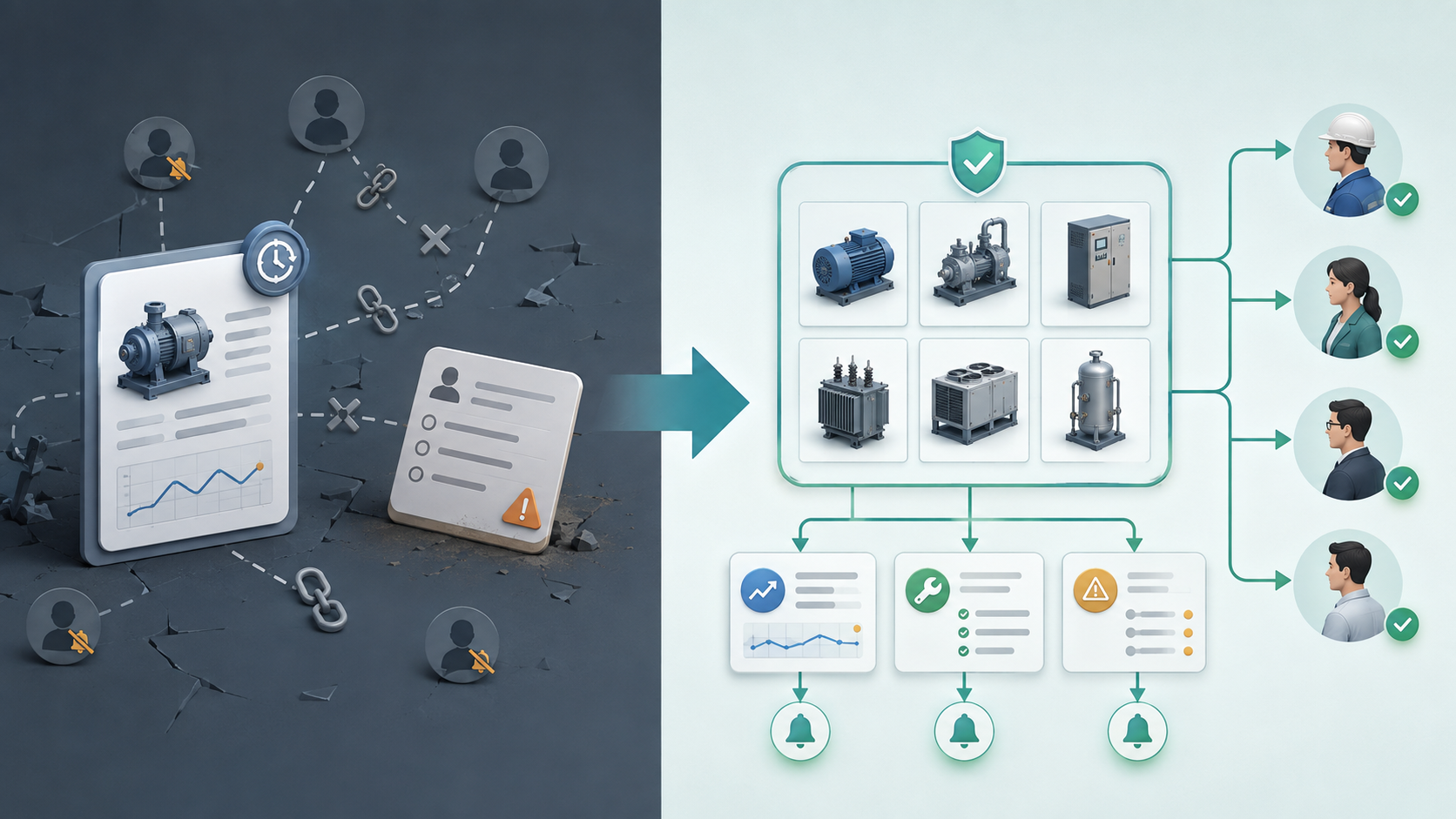
Three Breakpoints
Looking through Xiao Zhou's troubleshooting process, these three breakpoints do not appear independently.
One: Object Scope
At first, he does not know which group of assets the "payment callback timeout" should map to. If the scope of attention relies only on a manually maintained list, new instances, migrated gateways, or adjusted relationships may fall outside that list.
Dynamic scope is better described by model and conditions, such as key hosts in production. High-value objects with clear boundaries and small numbers are better specified directly as instances. The two methods solve different problems and cannot be replaced by one broad rule.
Two: Change Semantics
After the object is found, the problem is not over. Owner changes, property changes, relationship changes, upcoming expiration, instance creation, and instance deletion all lead to different follow-up actions.
Compressing them into one notification saying "the asset changed" may look convenient, but the recipient cannot judge whether they need to act. An owner change may only require handover synchronization. A key dependency change may require upstream and downstream review. An upcoming expiration often needs to go to a resource or renewal owner.
When the message lacks semantics, recipients can only guess from experience again. The second round of delay begins there.
Three: Responsibility Destination
The last layer is the easiest to ignore: who should receive the message?
The on-call group needs to know about changes that affect current handling. Service owners care more about responsibility and dependency boundaries. Asset administrators need to pay attention to lifecycle and model governance. Putting all of them into the same full-notification group does not improve collaboration efficiency or create a traceable handoff relationship.
At this point, Xiao Zhou is not just missing one message. He is missing a clear path from "change happened" to "responsible person confirmed."
Technical Insight: Changes Need to Be Consumable
Asset relationships do not end after they are modeled and stored. To work in operations, they need at least three states:
- Locatable: during a failure, the team can quickly return to the correct instance and relationship.
- Noticeable: after key changes happen, relevant people can receive signals within the right scope.
- Traceable: when disputes appear, the team can return to previous and current values, change scenarios, and source evidence.
With only the first layer, CMDB becomes more like a static repository. With only the third layer, the team can only review after the fact. Adding the second layer lets asset facts start entering daily collaboration.
Use Subscriptions to Constrain Scope
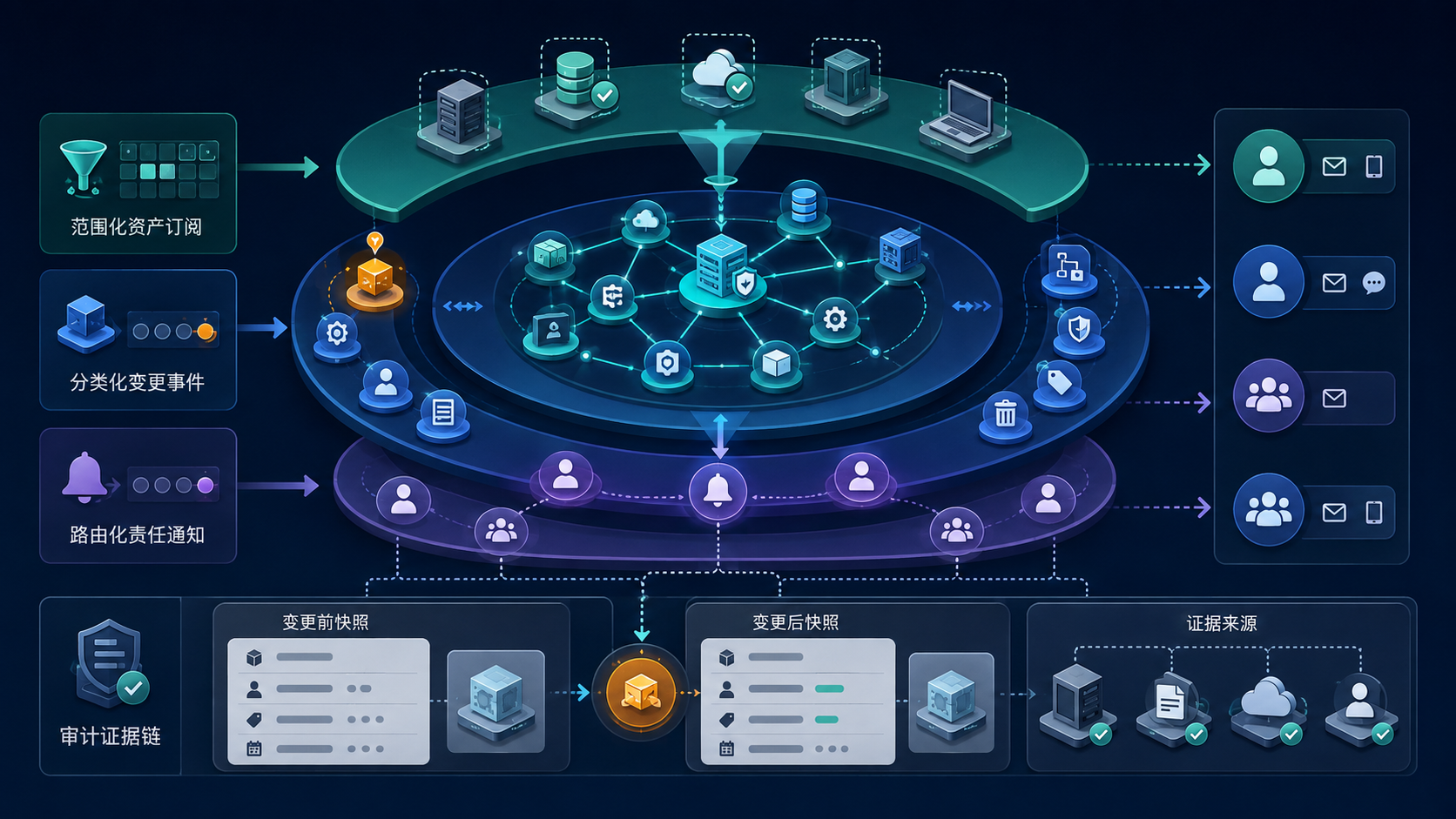
BK Lite CMDB data subscription fits exactly into the chain of "how a change becomes visible after it happens."
Rules can define the scope of attention by filtering conditions or by directly specifying instances. Property changes, relationship changes, upcoming expiration, instance creation, and instance deletion can all be trigger conditions. When relationship changes are involved, one rule can also listen to multiple associated models. This lets service owners avoid waiting for a ticket before temporarily judging whether "this change is related to me."
Notifications can specify recipients, recipient groups, and configured notification channels. The system checks new changes after the last execution based on an incremental window. Multiple property changes on the same instance are merged into one notification with a summary of changed fields. When a batch of instances exceeds the single-display limit, they are presented in aggregate. The point is not to create more reminders, but to let recipients first see which asset and which kind of change deserve their attention.
Bring Notifications Back to Evidence
Subscriptions push changes in front of people, but they should not replace verification.
When Xiao Zhou receives a change summary, he still needs to return to the change records and confirm: did this update come from manual editing, automatic collection, system handling, import, or synchronization? When did it happen? What were the previous and current field values? BK Lite CMDB change records support filtering by change type, change scenario, operator, and time range, while keeping source and scenario separately preserved.
This step matters. A notification without an evidence chain easily becomes another hard-to-judge message. A record without active awareness can only be found after a problem occurs. Together, they form a closed loop of "notify first, verify next, and review later."
Questions to Ask Before Starting
Do not enable full subscriptions for the entire CMDB from the beginning. First narrow the scope around a small number of objects that most often slow down incident handling:
- Which core entrances, key databases, shared middleware, and cross-team dependency objects should be included first?
- For each type of object, who confirms property changes, relationship changes, and lifecycle changes?
- After recipients see a summary, do they know which change record to return to for verification?
- Are the basic data fields such as owner, environment, and relationship already trustworthy enough?
These questions do not have standard automatic answers. Subscription rules are constrained by organization scope, and notification channels depend on already configured channels. They will not decide for the team that a certain change is definitely dangerous, and they are not incident alerts or impact-analysis tools.
But once these questions are made clear, many collaboration problems that used to appear only during failures can first become routine confirmations.
Reconnecting the Layers
Return to the month-end settlement ticket. If the payment gateway and key dependencies had been correctly scoped, responsibility and relationship changes had been separated into semantic events, and notifications had only gone to the people who needed to confirm them, the first thing Xiao Zhou saw would not have been an outdated contact and old relationships.
He would still need to determine the cause of the failure and still need to check change evidence. But object confirmation, responsibility confirmation, and relationship confirmation would not need to be pieced together from zero.
The value of an asset ledger is never just how many fields it stores. When the environment changes, whether facts, responsibility, and collaboration can update together determines whether it becomes the starting point of troubleshooting or a table that can only be checked after the fact.